The Alliance Alert newsletter presents it's Fall 2009 edition.
2009 ADE Minority Broadband Summit – DC
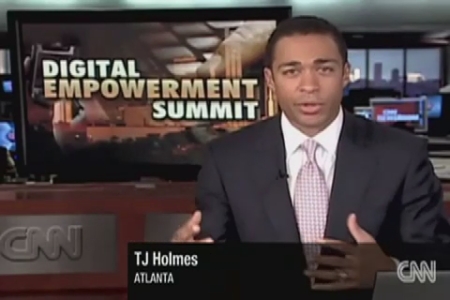
On November 18, 2009, the Alliance for Digital Equality brought together a prominent mix of policymakers, thought leaders, and media at our 2nd Digital Empowerment Summit held in Washington, DC: "The State of Underserved Americans in the Midst of the Broadband Revolution." The event, moderated by CNN's Roland Martin, featured community leaders and elected officials. We were pleased to be joined by Congresswoman Donna M. Christensen (D-VI), Congresswoman Eddie Bernice Johnson (D-TX) and Congressman Silvestre Reyes (D-TX), who each took the opportunity to deliver remarks to over 70 attendees at the Newseum.
Here are short excerpts from the remarks of each Member of Congress:
Congresswoman Donna M. Christensen, reflecting on current affairs on the Energy and Commerce Committee: “We’re closely monitoring on the Energy & Commerce Committee a broadband technology opportunity program and the broadband initiative program that was created with the American Recovery and Reinvestment Act. We have had several hearings in Energy & Commerce on the rollout with the National Telecommunications and Information Administration and Rural Utilities Service most recently in September. We are very pleased with how they are working together… I understand that they are now looking at about 2,000 applications for that last round.”
Congresswomen Eddie Bernice Johnson, talking about underserved areas in the US:
“I find that many of the countries that we consider ourselves a little ahead of might be ahead of most of us in this field. Because we do very well in our urban areas… we do not do as well in our rural areas. It’s causing many people to move, so our urban areas are becoming very, very crowded because we are causing a lot of movement and changing so that people can be where they feel that they can be in on what is going on.”
Congressman Silvestre Reyes, giving his perspective on the digital divide:
“The Congressional Hispanic Caucus (HC) is particularly interested in this topic because the digital divide is very real and is a very big challenge for communities we represent… addressing the digital divide is important if we are serious about moving everyone into the 21st century.”
Following these presentations, we had a diverse group of thought leaders and media personalities that participated in a series of three panels. Each panelist spoke about the importance of broadband Internet access for underserved communities, offering diverse and compelling perspectives. Participants discussed specific strategies for bringing broadband access to underserved communities and the need to keep broadband affordable as well as to provide exposure to high-speed Internet in schools and community centers as an useful tool for driving adoption.
Panel topics and respective panelists included:
“State of Broadband in Minority Communities”
John Marks, Mayor of Tallahassee, ADE Board Member
Gretchen Livingston, PEW Hispanic Center
Lee P. Brown, Former Houston Mayor & Drug Czar of the Clinton Administration
Jim Shelton, Assistant Secretary of Technology & US Dept. of Education
Casey Lide, The Baller Herbst Law Group
Courtney Lang, Pfizer
Rick Hermann, Intel
“The Wireless Broadband Revolution”
Roger Entner, Nielsen
Dr. Jay Sanders, Global Telemedicine Group
Jose Jara, Imagen Communications, LLC
Dean Brenner, Qualcomm
Mario Armstrong, Mario Armstrong Media, LLC, Radio & TV Technology Talk show host, NPR Morning Edition Tech Expert
Mark S. Adams, Northrop Grumman Information Systems
“The Social Benefits of Broadband”
Kenneth R. Peres, Communication Workers of America
Atty. Tony M. Clayton, Southern University Systems
Daniel R. Wilson, The National Caucus & Center on Black Aged
Mary S. Harris, BioTechnical Communications, Inc.
Victoria DeFrancesco Soto, Northwestern University
Gregory Fehribach, The Fehribach Law Group
We were pleased to cover such a broad range of topics, and look forward to continuing this important exchange in our pursuit of ADE’s mission to facilitate and ensure equal access to technology in underserved communities. By opening the door to economic and educational opportunities, better health care, personal enrichment and political power, broadband Internet access has become a transforming technology that can help narrow the gap between society’s rich and poor. In advocating for broadband access for all, ADE will continue to encourage policies that ensure broadband remains affordable, so that the unemployed and underemployed can acquire the necessary skills to secure meaningful employment.
The eighth floor room overlooking our nation’s capitol provided standing room only as attendees came to learn more about these important issues. The audience was filled with an array of government agency officials, staffers from offices of Members of Congress and leaders of national advocacy organizations representing a multitude of diverse communities.
Also in attendance were several reporters and bloggers who were actively engaging in the discussions as evidenced through numerous live Twitter updates and blog postings. Winter Casey with Broadband Census wrote a great piece entitled Summit Speakers Want More Broadband Access For Minorities, Criticize Net Neutrality that was published immediately following the Summit.
Overall, the event was an enormous success. We were able to bring together some of Washington, DC’s greatest minds to discuss an assortment of issues in addition to broadband for all, which are all of great importance to ADE and our member communities.
We hope that you will view highlights from our 2nd annual Digital Empower Summit here and that you will join us in Los Angeles for our upcoming Summit on January 15, 2010.
ADE's Learning Without Walls National Initiative
Learning Without Walls (LearningWOW) initiative is aimed at enhancing student performance, literacy and self-esteem, while enabling families to obtain the career development services they need to thrive and remain competitive professionally. This initiative provides tutorials to English and Spanish speaking students and utilizes broadband technology to research reference materials and receive online homework assistance from live tutors who are available for live chat services 7 days a week. The LearningWOW program also provides the students’ parents with access to an Adult Career Center for workforce development and job search preparation.
LearningWOW includes secure online communication between students and teachers, classroom management tools, coaching for teachers, and after school online tutorials. The tutorial program is offered to students K-12, introductory college level and adult learners. Teachers post resources, assignments with due dates, monitor student communications, etc. Students post assignments, communicate with other students and with teachers, create blogs, etc. This is all done within a safe environment via a school defined community. In the classroom, student computers can be monitored from the teacher’s computer to ensure each student is keeping up with the lessons. The after school tutorial provides homework assistance in the areas of math, science, social studies, and English. To ensure there is a strong foundation on how to incorporate broadband tools into the curriculum, coaching is provided for teacher support.
ADE LearningWOW Program Components
Student Learning
» Online Tutoring/Research Tools
» Teacher/Student Portal
» Interactive Whiteboards
» Teacher Coaching
Workforce Development
» Resume Writing
» Job Skills Training
» Health Education
» Financial Literacy
In 2009, The Alliance for Digital Equality (ADE) launched the LearningWOW initiative in North Clayton County Middle School in Clayton County, Georgia and at The Charleston Development Academy in Charleston, South Carolina. In late 2008, Georgia’s Clayton County Public Schools was the first U.S. public school district in 40 years to lose its accreditation. A conditional restoration was granted in May of 2009 −− It became evident to educators and Clayton County public officials that in order to regain the trust of the community and to empower the lives of its student body, a new approach to learning had to be developed. The Alliance for Digital Equality™ took on that challenge. ADE has implemented the LearningWOW program in Atlanta, Georgia and Charleston, South Carolina. The program provides students laptop and desktop computers with Internet connectivity so that they can have access to the Program within and beyond the walls of the classroom. ADE will expand LearningWOW’s footprint in unserved and underserved areas across the nation in 2010.
Highlighting ADE’s Digital Empowerment Council Member - Bernard Link
Bernard Key of Key LInk Technologies, a member of our Chicago Digital Empowerment Council, has been active in the Chicago area for over twenty years - leveraging the use of technology as a springboard for our youth to become competitive in the areas of science and technology on the local, national and global stage. Bernard has a number of community initiatives and partnerships in progress in the Chicago area:
• BIG “Blacks In Green” - creating green jobs in the African American communities through the use of broadband technology
• Englewood Task Force – grass roots organization to implement broadband projects in the Englewood, Gresham areas in the city of Chicago
• Northern Illinois University Broadband Initiative – serves as a partner to assist with establishing a broadband plan for underserved communities within Illinois (estimated $23 million dollar)
• NSBE National Society of Black Engineers – honored for technologist of the year in 2007 and received a community service award for afterschool program (mentoring program to address the digital divide through mobile and broadband solutions)
• Chicago Public School – Upgraded their land-based systems to wireless (Englewood Urban Prep School for Boys, South Shore High School, Gallistel Language Academy
Bernard’ s work embodies our mission at ADE, “empowering communities across the digital divide” – we are very pleased to have him be apart of our Chicago team.
ADE Board Member helps to jumpstart our Tech Exchange National Program
The Tech Exchange program is a national initiative aimed at providing seniors and youth with technology based educational and employment resources. Additionally, this Alliance program promotes providing life skills needed to enable seniors and the young to lead more financially independent and rewarding lives through the use of refurbished computers and wireless/broadband technology.
ADE’s Board member, Marvell Mitchell, CEO Mitchell Technology Group has been instrumental in giving us a jumpstart for this national program. Our first batch of computers totaling 12,000 are being refurbished by youth in underserved communities under his direction. These refurbished computers pre-loaded with an universal operating system and applications platform, will be dispatched to underserved and unserved communities throughout the U.S.
Senior Tech Exchange Program – encourages self-sufficiency among the senior community through computer literacy and job readiness training. As personal computers and the Internet become increasingly important in our society, many seniors are being left out, not because of too little interest, but because of too little access and too few opportunities to learn the necessary skills for self-sufficiency.
The Senior Tech Exchange Program is a broad initiative designed so that technology can serve as an equalizer for people of all ages, removing workplace barriers and increasing employment opportunities while reducing social isolation. If seniors have access to technology combined with technology skills, this dynamic duo of abilities will give many seniors a wider range of social and economic opportunities, enabling them to change careers, stay employed longer, and expand their ability to contribute to their communities through working and volunteering.
Youth Tech Exchange Program – encourages leadership and self-sufficiency among teens and young adults through computer literacy, living skills and job readiness training. Emphasizing age groups from 14-21, this Alliance innovation provides opportunities for young adults to learn and experience life-changing activities that use their growing skills in their communities. With respect to the future of our communities, these young adults can contribute immediate and continue making deposits that will outlive them.
Through the use of recycled computers, this vital project will enhance quality of life through the use of technology and empower both seniors and youth to fully participate and compete in our increasingly digital society.


 Welcome Message